As usual, @PulkoMandy is very modest concerning Haiku - and he is not the only developer doing that. What a user needs to “just use their computer” depends heavily on the particular user.
Most people don’t use the touchpad; I certainly don’t (even though it works) simply because it is the worst pointing device ever invented. Dual display support or switching to external display and vice versa would be nice but again, I rarely use this feature. I’m not sure even the average Window$ user would consider this a deal breaker.
Now, sound is a more important issue, and I can easily see why people would reject Haiku just because of that. Maybe I was lucky, but audio playback was never an issue for me in all my machines. However recording audio using my own API has issues, and I have no idea why (works perfectly on GNU/Linux and FreeBSD).
I’m sure many people would complain about the lack of bluetooth. Personally, I can live without it, but others won’t. It all depends on the user.
There are certainly “rough corners” in several places, and hardware compatibility issues. This is the reason many people like using Haiku but also use another OS as their daily driver. Still, the point where Haiku was just a “toy” for the curious “hacker” has long gone. I don’t know if I am wearing “rose-tinted glasses” but personally I am willing to accept rough corners for the simplicity and snappiness of the system, not to mention the “fun factor” involved while using it. Whenever I can, I’d rather use Haiku instead of something else. The good news is that “whenever I can” becomes more and more “most of the time”.
I understand why developers are typically being modest about Haiku, and I think that’s the right stance for them. But I also think sometimes they overdo it.
I think everyone in this forum is in a similar situation.
And also, comparatively to Windows, we are making progress because Windows keep getting worse with every release.
But still, some people who would have used computers 20 years ago and are getting fed up with the current state of things are not moving to Linux or Haiku. They’re moving to tablets or phones.
I have no doubt that Haiku has its userbase (I am part of it, despite all the problems I see, because I still consider it better than anything else available for my needs). But I don’t think we are in a state where I would run install parties and make anyone who comes there switch to Haiku, and promise them that it will work reliably, and that they can get around without specific knowledge and without support. It’s just not there.
Is it a problem? Not in the short term. Let’s focus on people who are already a little knowledgeable about computers and willing to look under the hood. Let’s keep in mind that we are not where we want yet in terms of hardware support, web browsers, and all kind of little things, and let’s keep progressing towards it. And as we do, we can indeed reach users that are less technically inclined, and just want to use their computer without any knowledge of the inner details. Or maybe let’s make some of them more enthusiastic about understanding how their computers work.
In other words, don’t be these guys and overestimate how much people understand about geology computers:
I had to buy new hardware (a few years ago) in order to keep reasonable build times for WebKit. My desktop machine from 2014 now takes days to build it.
The T460s is 10 years old, and the other ones you mention are much older. Sure, no problem with that for Haiku, but that is not the hardware you will encounter for most “general public” users.
You are right that most people aren’t using old Thinkpads (or other machines), but they are cheap and capable and therefore a good recommendation for people who want to try Haiku.
As for the switch to mobile phones, that’s a different matter, and I think irreversible. But businesses still use proper computers, either desktops or laptops, and I don’t see that changing in the foreseeable future.
It’s unfortunately true that many people are moving to phones and tablets and some don’t even have a computer anymore,but I really don’t think that are the same people that loved Windows up to maybe Win7 and are fed up with how it’s progressing.
Phones moved into the same direction even faster and earlier,they’ve been awfully locked-down since their early days and never had any good UX that made you get your work done without distractions.
One of the biggest reasons why I love Haiku so much is that it didn’t adopt the awful UI/UX choices of touch devices that most desktop systems have adopted nowadays.
I’d like my phone to be more like a computer that I own and where I can do anything I want,not my computer be more like a locked-down walled-garden phone that I paid for and still don’t really own.
I know, but the T460(s) is reasonably fast (for Haiku, not so for Win11 ),
has good build quality and you can get it dirt cheap.
The main problems (in my experience, at least) with newer Laptops is Touchpads not working due to i2c and framebuffer only mode, so no brightness setting.
I use a T480s, and I’m in pretty near the same place – better in that the touchpad works, but it’s over sensitive in a way that makes the keyboard hard to use. I don’t think PulkoMandy is being hard on Haiku at all, if anything he stops short of a full reckoning with the problem because he doesn’t mention the limited 3rd party software. Who uses a webcam? Who uses laptops? Who buys computers without researching Haiku compatibility? Who needs to have 100% access to web browser features? Ordinary users, that’s who. The only thing Haiku has to offer in compensation, is something ordinary users don’t value at all.
That isn’t the end of the world. We have reached only a small fraction of the people like us.
The problem of limited third-party software is perhaps the biggest stumbling block, and it willl never be solved by writing native versions. We don’t have 1,000 years.
But there is a solution, and that is WINE, working properly. If we want Haiku to grow, that is what is most needed. IMHO.
Layers will presumably help to port popular software, but there are a huge number of programs out there that only a few people use, and which will never justify the time spent to make them usable in Haiku. To the people who use them, however, they are indispensible.
That’s why we need WINE, or an equivalent.
BTW, I am totally non-technical, so if I have misunderstood what layers do, please excuse me. And perhaps explain.
I think you understood me [edit: if not, ask ] : With layers I mean stuff like Wine, but in this case I mean especially an Xlib compatibility library/tool for Haiku, and similar like Gtk. Stuff that provides an API either to run programs from other OS binary, or to make them source compatible (can be built unchanged for Haiku.)
(There are also .NET, Java VM and some game libraries.)
I don’t get this, I’ve never bothered to check compat beforehand. Sometimes I obtain computers, got some thin clients, got some laptops etc. School throws em away, business throws em away, refurbished, hands me down from friends etc.
Almost all of these devices have multiple problems, that really everything works is super rare. It really isn’t the users fault for “not getting the correct” stuff. I wouldn’t recomend getting a high-end overpriced nvidia gpu right now either just because there is some driver support Maybe it will break the next version, and then, well sucks for you.
As an example i just bought some thin clients “wyse 3040”. The internal storage is unsupported, sound doesn’t work over DP, or over 3.5mm jack, video is unsupported over the intel driver hence no display brightness over displayport, it detects 2 non-existant batteries. etc.
My main computer (to build webkit with) randomly doesnt boot with my 4k display connected. The other PC mysteriously doesn’t boot when i use the m.2 drive and a recen haiku (but works fine with a 2024 version, despite the recent version working over usb)
Like, I have a huge array of computers to run Haiku on, but it basically doesn’t run without some issues.
EDIT: It’s also a really hard sell if you go “don’t throw your laptop away because of wndows 11, you can use your old one with haiku… No not that one, you should buy a new one that is actually supported”
Hello! Maybe my proposal is not very popular, but I believe we should bring back the nice tradition of paying for useful software. For example, I see commercial software made for platforms like Amiga, where even if the customer base is limited, looks like is enough to be commercially viable.
I remember how in the mid 90’s there was a big amount of “shareware” applications, that were made by small companies, or even lone developers. Unfortunately, that mid-size section was totally wiped.
Nobody prevents you from donating for software that you find useful.
Open-source has the advantage that it can be used also by people who otherwise couldn’t afford it,that it can be continued by someone else if the original developer loses interest and that you can check the code to see what it does to your computer.
I see only advantages with open-source software and honestly I wouldn’t use anything else.
But giving back is very important to support the continued development of software you use.
Even if you’re not forced to pay,you can do it anyway: Think how much you would have had to pay for a Windows license on your computer,then donate that amount to Haiku instead.
Don’t get me wrong. Nothing against open source (But I’m not against closed source either).
Would be wonderful if everyone fully donates enough money for funding open source, but you and I knows that this is not going to happen. And again, is totally respectable if someone want to sell his software.
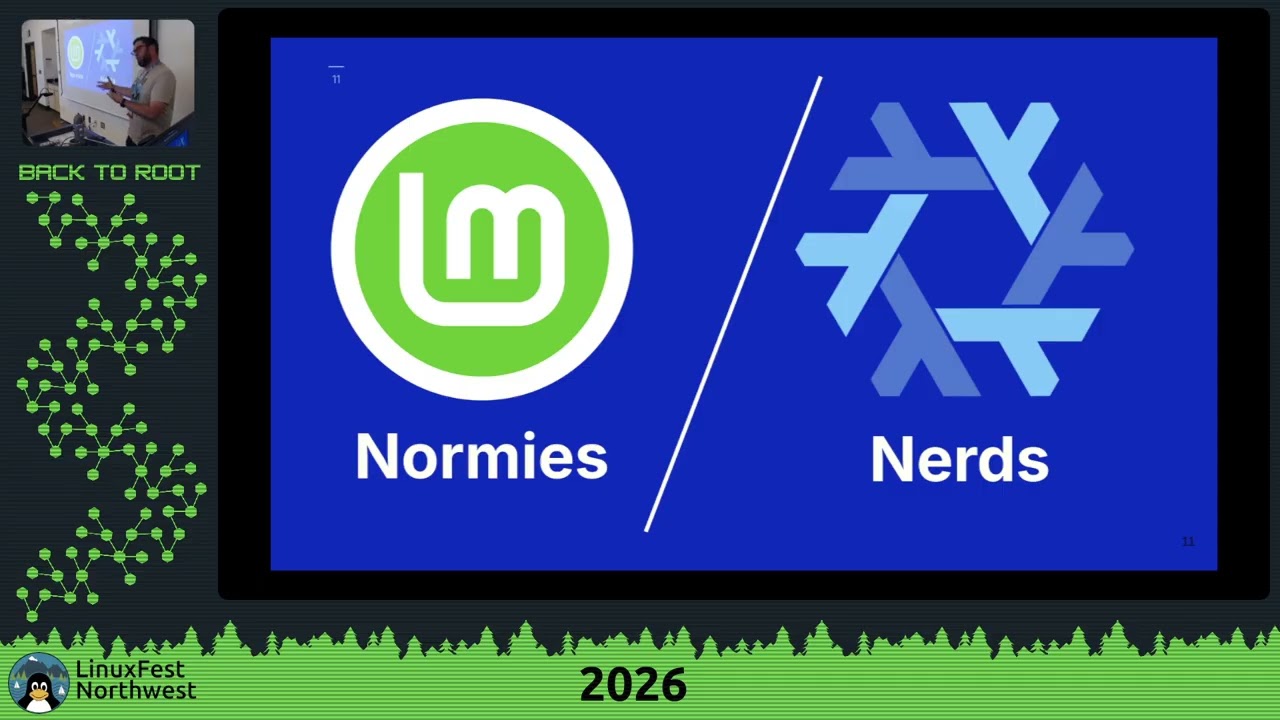
Well, recently I met this 2026 conference presention –
I would recommend to watch for all members here to envision the crowd will use Haiku anytime soon (due to Windows is getting worse, Linux is complicated as too much choices. MacOS hw is expensive, BSD is niche to use, etc)
I thought the real reason behind if average user would not use a computer anything, but Windows, is that : they have to learn new things, an OS, different programs that they had accomodated to … but finally not really is the whole picture.
It’s interesting to see how a Linux distro was built and configured - to meanwhile helps users to have a secure system against their decision making difficulties that comes lack of interest and knowledge as well – to work/run services silently in the background … explicitly the average end users have a PC just works. How very blocking can be a system message to run the update, as the message can interpret as update/upgrade carries some risk … so they skip it. Meanwhile the update may fix a memory leak or security hole. So interesting, I had not think about such reasons before.
It is a Linux OS distro for recycled computers for those persons / families in the US who cannot afford a (new) PC or any at all, meanwhile there are many conputers tossed away by persons and firms which that increases the number of e-Waste electronics per year.