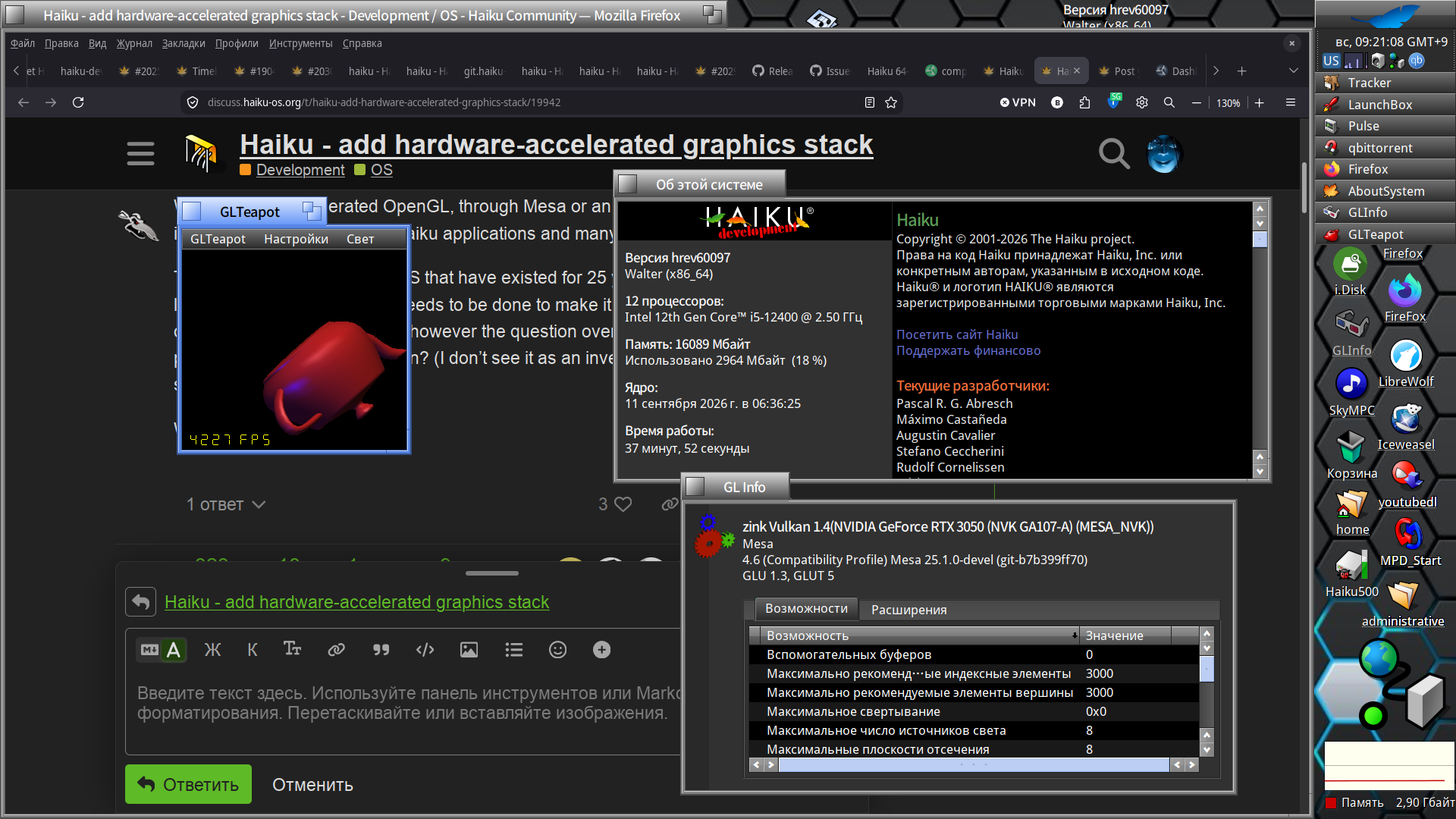
Haiku is developing very positively and it is great to see the beta 6 arrive recently!
I think that to really get wider attention to the OS, at the right time, it needs to be by addressing the the billion dollar PC gaming market. Especially as it is a consumer centric OS.
I want to be clear that I am looking forward, not trying to criticize Haiku of today!
If reliable kernel and driver support for common GPUs, including memory management, command submission, synchronization, display modes, and power management can be added. This would be an enormously strong foundation for Haiku to mature as a relevant consumer OS.
With a mature accelerated OpenGL, through Mesa or an equivalent stack, it would immediately benefit existing Haiku applications and many games.
This is not simple, yet for an OS that have existed for 25 years without entering the limelight - maybe something needs to be done to make it happen. I have donated to the development in several ways, however the question over time becomes - why? at this pace, will there ever be a return? (I don’t see it as an investment, I see it as a statement!)
For me the return is everyday in the joy of using and improving Haiku. With a project so fun, I have no reason to play videogames anymore, and that’s why I am not so interested in 3D acceleration
But I’m sure eventually someone will take care of it. In fact there is already some progress on various efforts, I think, and some already usable (with a few extra install steps) options.
GPU is only one part of the problem, another is Steam, Epic and other stores. Majority of games run only through those stores and their emulation layers (outside Windows). This will never happen since Epic (and Valve to some extend) have no interest in platforms outside Windows.
Here I beg to respectfully disagree. Spot on with Steam and it remains the dominant distribution platform, and rightfully so as alternatives have been really poor.
If Haiku gets wider adopted, I don’t see why Valve wouldn’t be interested. They are definitely in it for the revenue - so, why say no to another avenue for that? They just massively challenged the Windows domination in recent years with going Linux with Steam.
When (and if) Haiku adoption grows, so will the interest of it by big actors in the market.
There are already a few 3rd party projects in the works such as the Nebula driver that provides hardware 3D acceleration on NVIDIA Turing architecture and above cards, based on the open source driver. More about that on this thread.
I also see someone is working on hardware 3D acceleration for the AMD cards they have access to in this thread.
There has been a lot more work done on improving the situation recently as the above examples show, even if they are not an official part of the Haiku project.
As you are aware, this is a project of mainly volunteers with limited time and resources. If someone is willing to contribute in a way that speeds up the development pace in this area, I’m sure it would certainly be most welcome.
To add to this, my personal opinion is that the only chance haiku has of becoming “successful” in the traditional sense/meaning of mass-market adoption is if some Linux emulation layer of some kind was added
Linux already is successful in that regard, millions of people use it as their daily driver OS. Wine is impressive and important as well, but Linux is the FOSS OS with the clout to get things like Steam, and while I agree that it would likely be surprisingly trivial for any given company to port their stuff to Haiku (or any decent UNIX like with a mostly POSIX C library and relevant libraries), if we are being realistic, it’s not likely to happen anytime soon.
Fwiw making Linux applications run on non-linux isn’t even that stupid of a idea, I’ll see if I can find it later but I know a guy on the OSdev discord got Factorio running on OSes like Managarm before by creating a shim glibc library, FreeBSD has the Linuxulator or whatever it’s called
But also, do we want to be successful in the traditional sense in the first place? Of course it would be nice, but I’d imagine it would also be somewhat stressful for a lot of people involved in the project, while if Haiku remains a smaller but still well known project, if someone does break something, it doesn’t instantly become something that affects millions of people’s daily workflow or computers
I can only concur, overnight mass adoption would likely turn out to be a challenge. There is also so much code out there for linux that is portable and with the tools of today it should be possible.
I guess the core of the OS needs to be stable, and I think it is very good now in beta 6. Only then can the use cases expand with the constrained resources supporting the development. I think everybody supporting the project are heroes by dedicating the time and passion to the project! I tip my hat to you!
It’s stable, but I’m pretty sure most people who have stressed it one way or the other can agree that it has just enough stability bugs in it that it can’t be called “stable”, there’s a reason it’s still on beta 6 after all
Personally, I’ve had two main stability related crash issues in my latest couple week long haiku fixation (lol), one being actual data loss and one being that for some reason I can’t figure out, rebooting while having a ssh client connected sometimes (quite rarely) panics the kernel during some shutdown of something TCP related
But hardware-accelerated 3D isn’t just about games—it’s about a whole lot of other things. Starting with the fact that you can have true transparency in the system—something we still don’t have today—without overloading the CPU. And ending with 3D graphics software, video playback and recording support, video editing, WebGL, CAD, and VMs. Gaming is just one area where the GPU is needed for a smooth experience. Unless you plan to have a system where you only run solitaire or Sudoku—and most users have bigger plans for their operating system—almost every piece of software today uses the GPU to run efficiently.
To put it simply, an operating system that can’t utilize the GPU today isn’t suitable for general use—and it’s even difficult for niche use, because everything is written to leverage the GPU for smooth performance. Let’s face it—after 25 years, it’s about time. No one who uses a computer for normal work today will want to use a system that doesn’t support GPU-accelerated applications.
Almost never? That would mean watching video on the laptop, which I almost never do on purpose.
The only thing I do regularly on a laptop that’s likely to touch the gpu is graphics editing (which I switch to a Mac laptop for), and even if Affinity does use gpu it definitely doesn’t need to at the scale I work at.
I’m also one of those very rare people without any needs for GPU acceleration.
I don’t play games (except maybe something like snake,chess or 2048 which aren’t too demanding on graphics),I don’t watch videos,neither do I do any video editing.
Yeah,I understand many people need it,but I always find it funny to read statements like “No one who uses a computer for normal work today will want to use a system that doesn’t support GPU-accelerated applications” without even knowing the work of those other ones.
My text editor,IDE,web browser,mail client and messenger are doing fine without GPU-acceleration,thanks.
Speaking about a Linux compatibility layer,as it was mentioned in this thread and comes up frequently… If it ever gets done,I hope it will be a third-party application that I can simply choose not to install,just like Wine.
I know that some people want to run proprietary garbage,DRM-“protected” (read: locked-down) stuff and such,but I don’t.
Not having that on Haiku is a feature I’d like to keep.
Also,unlike BeOS,the Linux ABI is anything else than stable,so that will be a huge maintenance burden.
If a third-party developer wants to take this burden: Fine,go for it.
But in the base install where core developers will have this burden,I’d expect it to slow down more important work,such as drivers or native features or fixing bugs.
Better gpu support for haiku is certainly important, stuff like better modesetting, displayport link training for one (so we can properly support some displays); and then video decoding.
I don’t quite see what the oposition is to this. it’s certainly not “no need” for gpu acceleration, surely there is a need. Using the correct component does improve performance and efficiency. Alone for battery improvements correct usage of the gpu would be welcome, that does not mean that most tasks can’t also be done on the cpu, just that they are more power intensive there… which isn’t that great.
This atleast is false information, linux has a very stable ABI for userspace applications, which is what the question was about. The thing that isn’t stable is the in-kernel API, that is the part we would need if we were to port kernel space drivers.
(edit: I fail to see the point though, I guess steam is closed source.. but then most stuff running through steam runs through proton, which is based on wine… so we probably just want wine… at which point you can run the windows version of steam…)