SEN 1.0 Beta 1: your personal knowledge graph on BFS, now installable with pkgman

Some of you followed the first announcement of SEN in 2023. Today the first public beta is here, for Haiku R1/beta6 (x86_64) and later.

What it is: SEN (Semantic Extensions Native) relates files to each other and to things (people, books, papers, ideas) and keeps all of it in BFS attributes of your files: no database, no sidecar files.

Relations are shown by Akita, SEN’s version of Tracker with a few additions, as folders: a relation is a file named after its target, its properties are the columns, and the usual actions work (drag a file in to add a relation, delete a file to remove it, edit a column to change it). Drag a file out of a relation window and you get a deep link to the target (a page in a PDF, a section) while the relation stays.
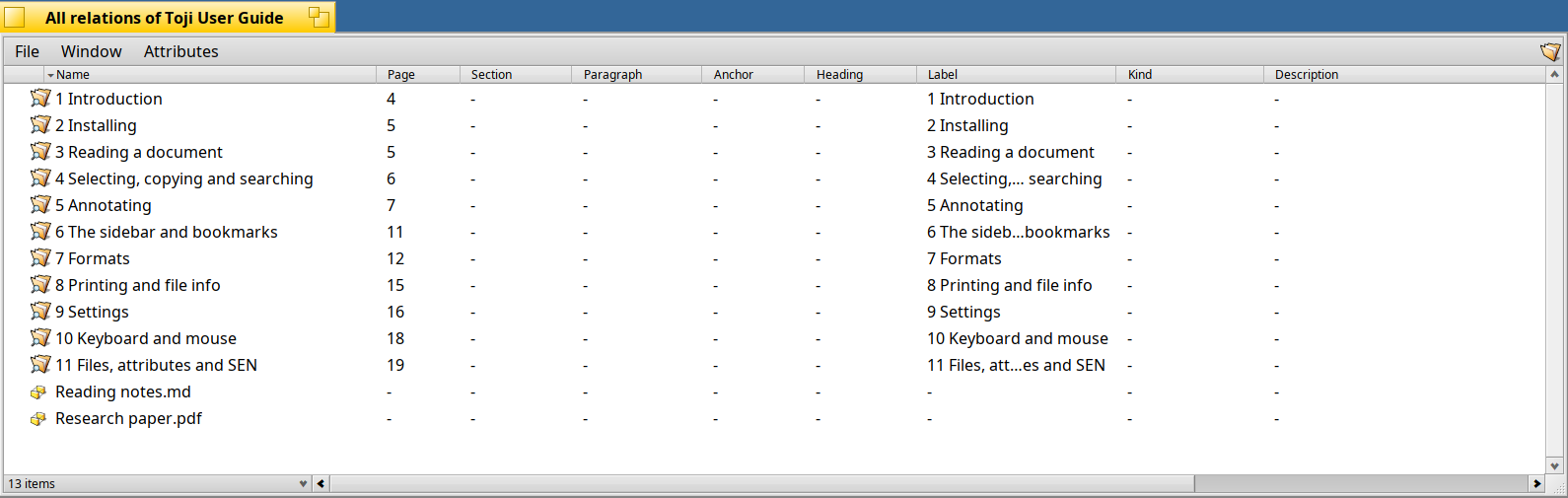
Relations of a PDF

What is in the beta

  • the SEN server with a menu in the Deskbar (contexts, classifications, plugins, ontologies, info and a consistency check)
  • Open related… (all relations of a file in one window, also what a PDF contains: its outline) and New related… / Associate with…
  • ontologies as packages (people, books, movies, music, papers, source code), with entities in the New menu, columns and queries for their attributes
  • plugins that find relations and enrich files: PDF and Markdown outlines, the #includes of C/C++, Python, Java, Go, Rust, JavaScript and TypeScript, book metadata from OpenLibrary, papers from OpenAlex and Unpaywall with their citations
  • a FileTypes that shows the attributes of the types of the ontologies
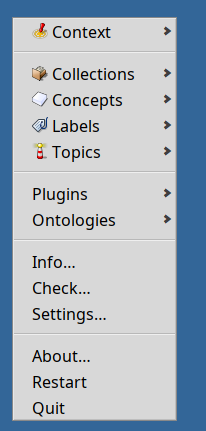
The SEN menu

Install

pkgman add-repo https://kiri.sen-labs.org/x86_64
pkgman install sen_core sen_plugins akita sen_filetypes
pkgman install sen_ontology_people sen_ontology_books sen_ontology_papers   # and the others, as you like

The server starts with the next login (sen start starts it now); Akita replaces Tracker at the next login (akita start / akita disable / akita restart). If you tried the preview: 1.0.0~beta1 sorts before 1.0.0~preview1 for pkgman, so remove the preview packages first (the exact commands are in the release notes); your relations are attributes of your files and stay.

Good to know: it is a beta, used for some weeks by one person: expect rough edges. It works on BFS volumes only. The names of the types of the ontologies are going to change with 2.0 (the types become identifiers of a registry, the same ones as on the macOS version that is being worked on), which is why this is a beta and not a 1.0.

Links: release notes · source · package repository https://kiri.sen-labs.org/x86_64

I am happy about every report, from “it does not install” to “I would use it for…”. If you want to try it, tell me what you tried to relate first, and don’t forget to hit that “Support” button if you find the project interesting or even useful! :slight_smile:

11 Likes

PS: as @us3r1d moved this to “proprietary & other” because - supposedly - of the use of Claude, see my stance on using AI and also note that 99% of all SEN components were developed over the last 3 years by hand and Claude was used to finish up some lose ends and tidy things up for the release. I proof-read the code and was very happy with the quality - even the aesthetics - of the code produced by Sonnet 5.5.

SEN is certainly not proprietary, as it is completely open sourced, MIT licensed, standards-based and data-centric, embracing the original BeOS vision of open data formats, pervasive use of common metadata, and open communication via messaging.

4 Likes

Fair enough, I make no statement about that; it is “& Other” though, as far as I could tell from the public GitHub repos.

1 Like

[quote=“us3r1d, post:3, topic:20284”]It
is “& Other” though
[/quote]

Why? Other what?

I shouldn’t try to be cutesy with my language; it just makes it unclear. My apologies.

This project fits the “Other” part of the “Software: Proprietary & Other” category because it is partially LLM-generated. This is very clear from the owner’s statements on the project web site and from Claude being listed as a contributor on the GitHub repos.

You are putting an open source project into a “Propietary” forum section (which is wrong), and using an “Other” category that nobody but the insiders know what it is supposed to mean. For a public forum, this is extremely misleading, to say the least. This situation also creates a negative reaction from the OP; understandably, I should say, as it must be disheartening for the developer of such a big, complex and interesting project to get this second tier treatment.

If the whole purpose is to tag (identify) projects that use AI one way or another, rename the section accordingly (or create a new section properly named for it) to avoid this confusion and the agravation is causes on the OP.

I say this with total respect.

2 Likes

I know that you know the forum’s policy on where discussions of LLM-generated software go; I have pointed to you (among others) several times as someone who is working well within the current policy. :slight_smile:

LLM-generated is one of the “& Others” types of software assigned to that category. Having a category specific to LLM-generated stuff has been suggested, but has not been supported by a majority of moderators so the current policy is that it goes in “Others”.

Hi @grexe

Congratulations on your release!

I have a couple of questions:

For someone not familiar with this type of software, is there a tutorial one can read (or view if it’s a video) for reference?

Also, does Akita replace Tracker?

Keep up the good work!

1 Like

Why? Other what?

What’s the point of this “just asking questions” tactic? You already know what the category is for, and if you did not you could simply read the category description…

1 Like

Almost a year late for :christmas_tree:SENtaClause​:christmas_tree: :wink:

2 Likes

haha well good things come to those who wait;-)

thanks, it’s really relieving to finally release the fruits of my years long work so other people than myself can actually get their hands on it and try it out!

The signal/noise ratio is certainly not optimal here - for every constructive feedback there are 10 unrelated complaints - but it’s an active community and certainly not disheartening, I am far too invested in this to be distracted so easily…:wink:

It just hurts my semantic brain to get miscategorized and just because I use Claude as a tool, the whole project is “tainted” with a generic tag that completely misses the point.

I just would prefer to have a more fact-based and less emotional, dogmatic discussion around AI - I guess in the 1960s, the same discussion was about compilers and people insisting to write machine code by hand, because those then fashionable shiny new compilers surely were not in the least comparable to brilliant hand crafted machine code;-)

Now to answer your questions:

  1. docs are coming, of course, this is a complex infrastructure that should still be easy to “get” and use. Currently, there are release notes and some preliminary docs linked in the announcement, and the blog will get much more meat on the components that make up SEN. I have a technical paper in the works, and intend to create a full documentation that can also be downloaded as an ebook. Also, there’s a YouTube channel and some old but still informative posts at my Substack, which will move to the new SEN blog eventually.
  2. Akita (Augmented Knowledge Interface for Tracker Associations) is a friendly fork to act as a clean separation and to avoid any trademark issues or confusion with the Tracker name. It has native support for SEN relations (e.g. an “Open related…” menu and an “Enrich” function) and will evolve from a simple file manager into a rich linked information browser as SEN grows.

Now back to the beta.3 release…

1 Like

Update: Beta3 is out now and Beta4 will be landing soon thereafter:

1 Like

hello. creating a link to a folder does not work in akita, but on stock tracker it does. i created a link to /boot/home/config/non-packaged/apps/ which crashed akita but worked fine on tracker. if there is another place to report bugs please tell me

Hi Grexe, despite having linguistic background (in semantic and semiotics) I cannot understand much of what is the actual purpose - what one can do with the application, apart from replacing Tracker (I wouldn’t).

What knowledge graph? what relations are being discovered and managed and why?
How that differs from using BFS database-like metadata/properties?

An explanation for simpletons like me in understandable sentences without baroque expressions would be really great and possibly help others, who are actually interested and do not care about LLM or no LLM.

4 Likes