Maybe build around something like the VisionFive 2?
Yes, that already exists. The Framework laptop. You can just start developing your software for it.
So I probably shouldn’t start something, others can do better right?
Just start developing software: I agree, I should do that.
Maybe I end up, starting a new Linux Fork, which decreases funcitonality in order to make it systemwise impossible, to do something else on it than productivity related stuff.
That’s after all the goal. There are too many temptations on our Computers, which disable us from what we actually plan and should do.
If you want a multi-os layer, maybe consider https://www.qubes-os.org/ as the isolation layer and running your OS on top of it.
That’s exactly what I need to do.
I want to call my OS, Detox OS.
Now I definitely need to become more experienced and simply keep learning every day.
Thanks to all of you.
These Computer Forums are way more supportive, than most places in the Internet.
I had an interesting idea.
It would be amazing to create an operating system, which can boot a PC system from a mobile device.
This would be perfectly sufficcient for web dev, data analysis or office work.

So librarys or offices would’t need to buy computers anymore, most of the time, in the future. They would only need to provide Screens.
This is the idea behind convergent PCs, which has been attempted multiple times by now:
- Motorola Webtop
- Huawei Easy Projection
- LG Screen+
- Windows Continuum
- Every non-Android Linux smartphone after MeeGo (except Sailfish OS)
There have also been Android apps such as DriveDroid which turn Android devices into live USBs.
1 Like
They already don’t.
Instead they buy “Thin clients”. Technically that is a complete computer, and could run it’s own OS. But in reality these run only firefox or chromium and stream a windows OS from a central server.
You know, like the good old mainframe days ; )
1 Like
I don’t know how well Haiku runs on current Framework generations but disagree it is what the OP is looking for. To my ears the proposal sounds like the MNT Reform. This uses compute modules based around single board computers.
Currently it only uses ARM based processors. Whilst Haiku’s ARM port continues to evolve, and there is no reason they can’t introduce a RISC-V compute module (on which Haiku is more advanced), the Reform also runs Genode/Sculpt.
Not only is this an “OS Framework” that can be used to build - indeed specialises in - minimal host for virtual machines to run diverse OS, it is also the basis of a fascinating project called Haiku on Genode which has been discussed here in the past. I have also speculated myself as to whether I would benefit from running Haiku virtualised on Sculpt in this post.
Only problem with the Reform is it is a hand-built product with price to match, but no reason why cheaper materials and mass producing can’t be applied (MNT is very strongly open source hardware).
I think, before defining a goal, I will try to become addicted to coding. This would solve many problems for me.
However is it that difficult, to find a 500€ paying coding job?
I live on my disability check and I would never benefit from higher salary, due to dumb tax regulations.
Does anyone here know something? I would work for free, until I’m useful enough for payment.
My rank on Codewars is 4 Kyu and I keep making progress, however the best I can do is the 6 Kyu ones and the very easy 5Kyu ones in Python.
Is that enough, to get started somewhere?
What would you recommend me to achieve, before trying to find work?
I have an (unrelated to Haiku) keyboard firmware project I would be delighted to brief you on. I would not recommend getting “addicted” to coding more than anything else, but would be happy to help nurture a healthy enthusiasm!
2 Likes
I installed Haiku onto a USB memory stick, and have been running it for a few days. It works, but only in the USB-A port. Boot fails if the same memory stick is connected to USB-C.
Yes, this memory stick has both A and C, one connector in each end. Great design. Fits both types of port. But haiku must use A for booting on my ThinkPad.
ChatGPT explains that USB-C is Thunderbolt, and not compatible with booting Haiku on ThinkPad. C only gets to the fourth square on the splash screen, and gives an error message that it could not find boot partitions.
1 Like
Sorry, that’s nonsense, usb-c is a commector type. Thunderbolt is a protocol, usb-c can support severall things and this has nothing to do with this issue.
If you got any icons then you already are in haikus bootloader or kernel, and this is simply a bug. please open a ticket at https://dev.haiku-os.org
2 Likes
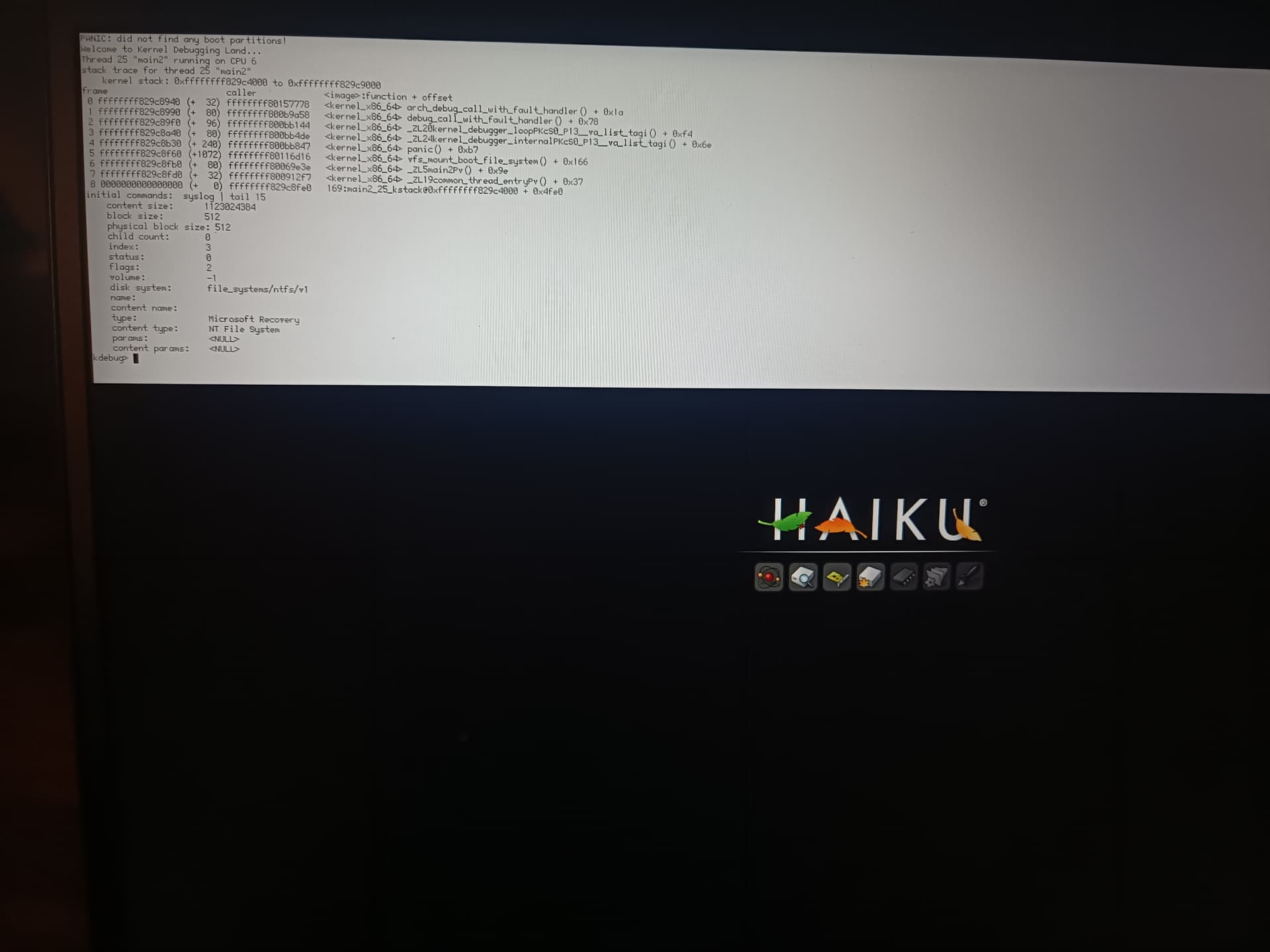
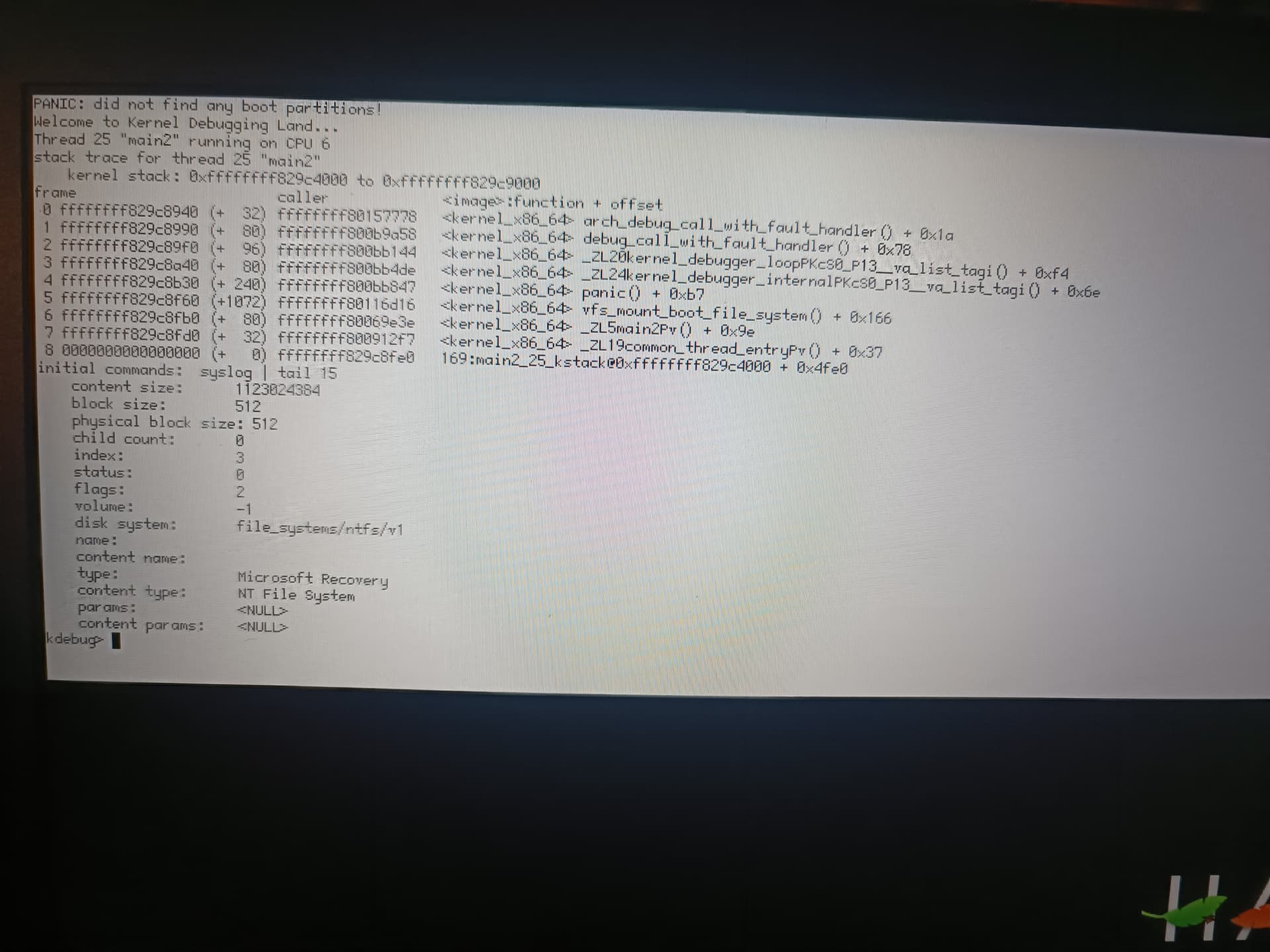
Here is the result of booting Haiku from the USB-C part of my memory sick. It boots fine with USB-A.
Why is there a reference to Microsoft Recovery? Yes, the PC runs Win11, but I run Haiku off a memory stick, and don’t want to involve the internal SSD.
Taking out the SSD gives a different error, but similar when booting from USB-C. USB-A always works. USB-C never does. I try several memory sticks in all the ports on the PC, sticks are made with both BalenaEtcher and Rufus. Type of USB-port is the only difference.
1 Like
What is the model of that memory stick?
This one with both USB-A and C is Sandisk 128 GB. Also tried Kingston 256 GB with USB-C only. USB-C always fails the same way, USB-A always works.
1 Like
In Terminal
listusb -v
listimage 1
1 Like
https://limewire.com/d/X3rxC#D1rCEqwukc
Output from those two commands
This is while running an installed copy of Haiku from a USB-A stick, with an identical USB-stick plugged into USB-C.
Again, these USB-sticks have both A and C. A always works with booting. C seems to read and write fine within the operating system.
1 Like
As I wrote above
1 Like