Do you even realize what you’ve written? Who told you that this—Firefox—is his goal? Did you make that decision for him? Or for his users? In what way does it fail to integrate perfectly into the system? Why are you speaking on behalf of everyone? And for the record, I wouldn’t mind at all if Firefox were the default browser. Its customization options and user interaction capabilities far surpass those of Web+, which lacks them entirely. That’s what you call competition.
If the choice is between enjoying one’s “native” but non-working browser and struggling with someone else’s “non-native” one, I choose to suffer.
The idea is obvious, but I, for example, often have 30+ tabs open—will it still be convenient?
Do you even realize what you have written?
This was a totally factual conversation before you brought in too much emotions.
It’s a fact that ported software doesn’t integrate as good as native software.
That doesn’t stop you from using it,and nobody says that,it just doesn’t look like the rest of the system.
Oh,and that decision is made by Mozilla by the way.
They want Firefox to look the same on every platform,even if that means a difference to the system design.
That’s the reason they designed it that way,while years ago it could still use the system design on each platform.
While it’s technically possible to make a custom design that makes it look almost like native,I bet we’d be no longer allowed to call it Firefox then (it would work with the IceWeasel branding however).
3 Likes
Was Web+ ported, or was it written from scratch as a native application? In this context, what is the difference between it and Firefox?
WebPositive was written from scratch using Haiku-native libraries (BeAPI) which gives it a fully native GUI and access to Haiku-specific features like filesystem attributes.
Only the engine for rendering the web content is ported (Apple WebKit),that’s the part that does the hard work in the background,but the user doesn’t see much of it.
Firefox is fully ported and built on top of cross-platform libraries,so that it can work everywhere without major changes.
It became a lot better after removing the need to render through GTK and Wayland,but it’s still not a native application.
That doesn’t mean that it’s bad,but that it’s not as perfectly integrated,which is mostly visible due to the different design.
1 Like
Question: Which API does the Firefox interface currently use for on-screen rendering? Is it via X11?
Apple WebKit also makes use of a whole host of cross-platform libraries. Even Haiku relies on a great deal of cross-platform code—everything from drivers to ZIP handling. By your logic, then, Haiku itself wouldn’t be “native.”
Yet, it’s not “native” either—it’s been ported—but for some reason, you label it “native,” while you don’t apply that same term to the Firefox engine. The fact that the interface remains consistent across all platforms is actually a plus. Imagine if a music editor had a completely different interface and set of configurations on every platform—how would anyone actually use it across different systems?
I’m asking: what exactly is missing for something to be considered “integrated”? Is the ability to write to file attributes just a way of showing off that “we can do this”?
The pursuit of “nativity” has essentially become a religion, completely disregarding user convenience. I realize the Haiku developers are like the “Highlanders”—time doesn’t seem to matter to them, whether it’s 25 years or 50… They have all of eternity ahead of them, but users like me want to use Haiku here and now. For some reason, the OS’s most compelling features—like hardware-accelerated video playback or hardware-based video transcoding—still don’t work, yet the real point of contention is whether an application is “native” or “ported.” We’re categorizing applications based on some sort of “racial purity” standard. Let’s just wait another 50 years for things like add-ons and ad-blockers to finally appear in Web+; after all, the most important thing for an OS user is clearly whether or not an app can write to file attributes, right?
1 Like
Native usually just means that it uses the Haiku API where it makes sense, and that it uses the Haiku UI API (when it has a UI in the first place). It basically means that it supports Haiku features and specialities where possible.
3 Likes
I feel like I need to clarify a few things regarding everything said above, because the current Firefox port:
- Directly uses BWindow and BView to create native windows, and WebRender renders frames directly into a BBitmap
- Uses native BGLView to provide WebGL support
- Uses native cursors
- Uses the native system color theme
- Respects native system font settings, antialiasing methods, and hinting
- Directly uses native HVIF file icons by querying them via the native API
- Runs file type identification via the system API upon completing downloads, properly writing MIME attributes to the file
- Supports native bidirectional Drag-and-Drop. You can drop a file from Tracker, or drag a file or hyperlink out of Firefox. When dragging a bookmark, native file attributes are read/written, resulting in a proper native bookmark file
- Features system clipboard integration, allowing text and images to be copied and pasted in both directions
- Uses native notifications
- Uses the native API for gamepads and joysticks
- Uses native MediaKit (backend modules added to cubeb) for audio playback and recording
- Uses native MediaKit (modules added to webrtc) for screen capture and video nodes (e.g., webcams)
- Uses native file dialogs
- Supports serial ports
- Respects the system keyboard layout
- Uses native ports for IPC
Honest question: what else is missing for it to be considered native?
26 Likes
oh my, im so sorry that the barely 20 developers and 3 gsoc contributors dont have an os that is so much advanced
i mean, do you even understand how hard it is to write an os from scratch, have it be compatible with a closed source system, running an entire non profit organisation, running a bunch of services from the community, and receive insults from people like you?
truth is, you need large corporate funding to turn an open source system into something that rivals windows. look at linux for example. before 2021 thousands of people like these haiku users said that linux was daily drivable and better than windows but people like you always said something else was mssing then when valve came along and released proton suddendly linux started developing at a super fast rate and now you can run ubuntu just fine on very modern hardware with almost no issues
you cant complain about haiku being slow when it receives nowhere near the funding that debian or canonical get. if haiku did have the funding then it would have come out in 2010 like how zeta was developed so quickly
besides its not some high horse thing that we want native software. we want to avoid the bloat that linux is known for. i mean, think about it. why install gtk, qt qsystray, gstreamer and all when haiku has built in functions for them and when these apps dont even try to integrate with haiku. how about you get off your high horse and realise haiku is made by hobbyists not someone like microsoft
4 Likes
I was an active BeOS user back in the day, so there’s no need to lecture me about the number of developers—what matters isn’t how many there are, but what they’re actually doing. You could change the shape of your windows with every release, like some other operating systems do, or you could focus on doing the right things. For instance, I can see that the OS developers have squashed a huge number of bugs that had been lingering for years; I’m grateful for their hard work.
A couple of questions for you:
- If Haiku is so good, why does it have so few developers—and where did the previous ones go?
- And what, in your opinion, should be done about Qt in Haiku? If you don’t like Qt, you’re perfectly free to simply not install or run programs that use it.
- haiku is non profit and niche so there are less developers then say ubuntu or debian.
- let qt be there. i simply said that the reason people like native apps is because it doesnt take up as much resources as a qt or gnome app. so naturally people will prefer the native apps.
but im not understanding you. by the tone of your other message it felt like you were being rude and thought the haiku team didnt do anything important (you said they were on a high horse, and what you said about webpositive). sorry if i misunderstand you because my english bad
2 Likes
It is a native API “port”. No softwares designed for other platform first cannot be a Haiku native software. So Firefox won’t be the one.
LibreOffice or Blender are the same category’s software I think.
There is no OS that has the most popular web browser which is native for the OS. Safari is less popular than Chrome, IE…MS Edge is less popular than Chrome, GNOME Web/Konqueror are the same.
Some categories of software are too complex compared to the platform it runs, so the feature-full most popular app will be the one designed for multiplatforms.
I hope WebPositive is the feature-selected simple preinstalled browser that provides WebView for embedding.
6 Likes
Fair enough, I agree. An application’s “nativeness” is determined by the target platform for which it is originally created.
7 Likes
I’m not really sure what you are attacking, if you want Firefox to be your default browser you can set it as such. It is fine for what it is, but the expectation that it’s innards be ripped out and replaced with native apis makes no sense. Firefox does want their rendering to be the same on all platforms.
[to OP] That is really amazing to read. Firefox has been working perfectly on Beta 6.
*I wonder, did they try testing Firefox on a VM of Haiku themselves before approving?
1 Like
i think they tested it on bare metal
I am currently experimenting with WebGPU support (for now, only via the Vulkan software implementation - lavapipe). I have not yet managed to get any image output using the experimental Nebula driver for NVIDIA (created by @x512), but I am continuing to work on it.
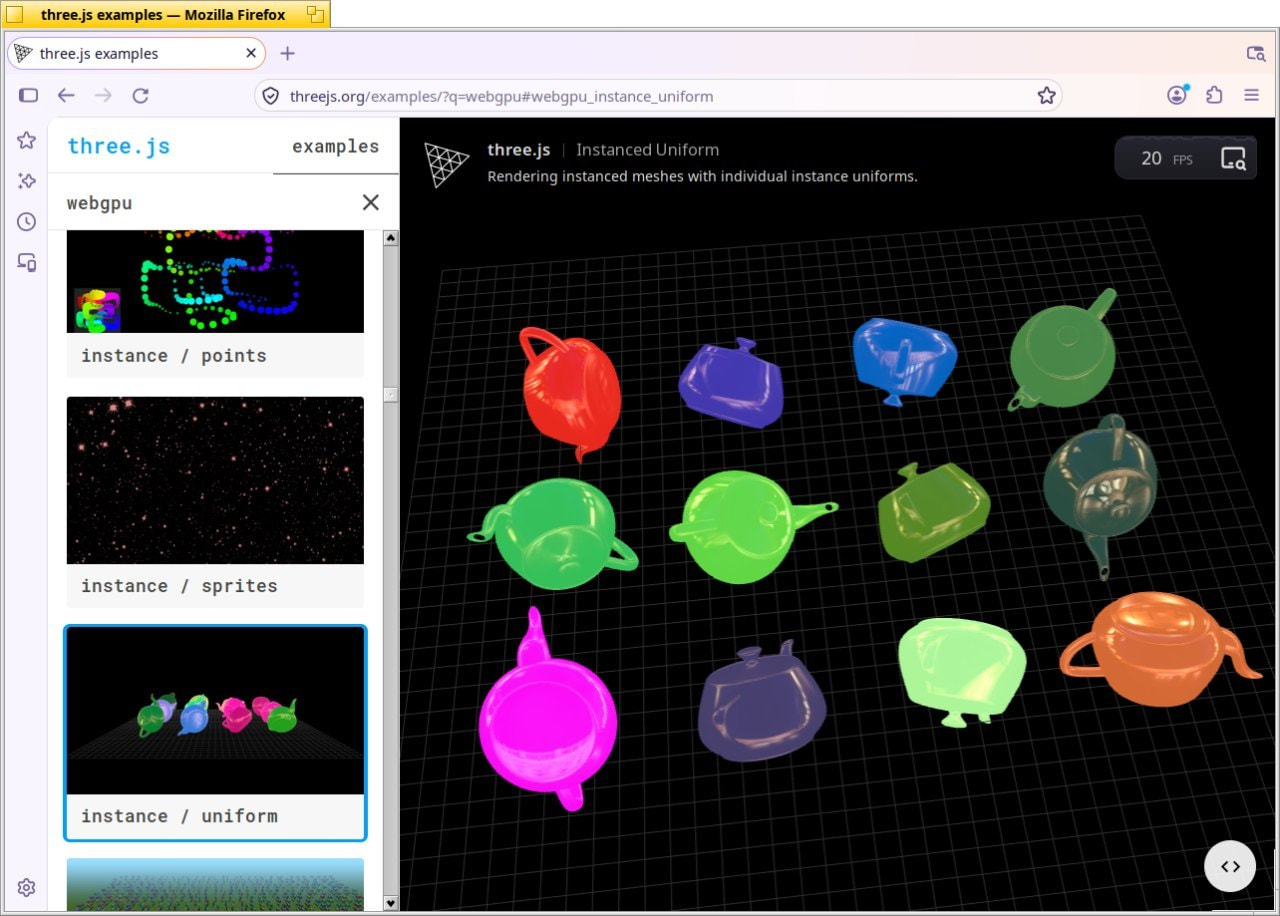
22 Likes
The nativized port of LibreWolf can now be used quite well with VMWare’s admin page (including the web-based console for VMs) so with ssh tunneling and autossh (to connect to the private admin vlan) that’s one less thing I have to switch back to the Mac for.
\o/
3 Likes
Hello @3dEyes ,
sorry for my ignorance, but I’ve noticed that the corners of pop-up windows on my Ubuntu system are rounded; in Haiku, they would remain sharp (see screenshot) - does it something to do with this point, or is it just your design choice?
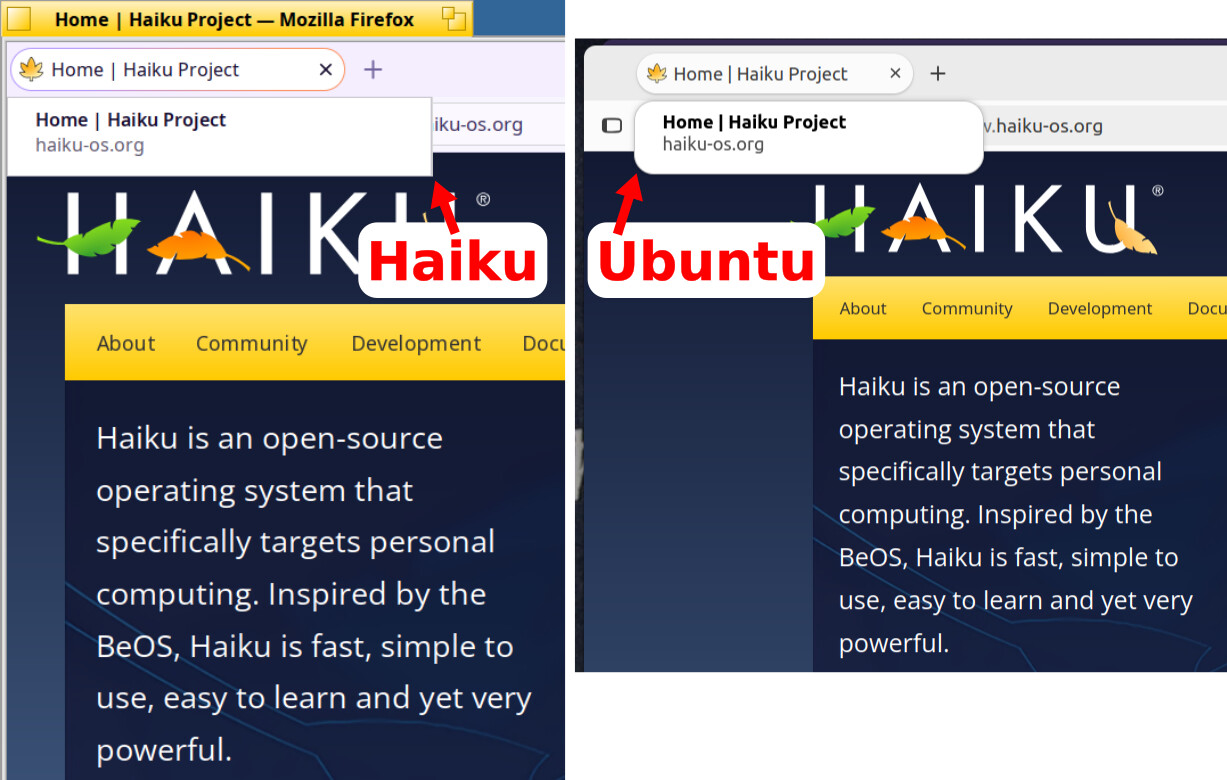
This is also the case for hamburger menu on the right hand side, extensions menu, login menu etc.
I also noticed that when I take a screenshot with build-in screenshot-app (which you get when you press print-key) and select there only active window, I get only a screenshot of this pop-up window, not the whole Firefox window.

That’s all not big deal for me, just curiosity. Thank you for your work.
Regards