Can’t wait for LibreWolf to get the native treatment; had to try Firefox. 
It took a while to go through and turn off all the ick, but damn the port works really well.
\o/
Can’t wait for LibreWolf to get the native treatment; had to try Firefox.
It took a while to go through and turn off all the ick, but damn the port works really well.
\o/
This is the first time that I have used a build with an official Firefox branding, and it looks like the bugs are gone. Amazing work on this!
Sounds like very good improvements,waiting for the new native port to arrive at LibreWolf to give it a try.
Won’t ever touch the spyware-enabled official Firefox,no matter how much “better” it is if it sells my data to the devil (Big Tech).
Anyway,no more need for Wayland and GTK and the whole dependency hell sounds like a huge improvement,looking forward to it.
That is super awesome! 
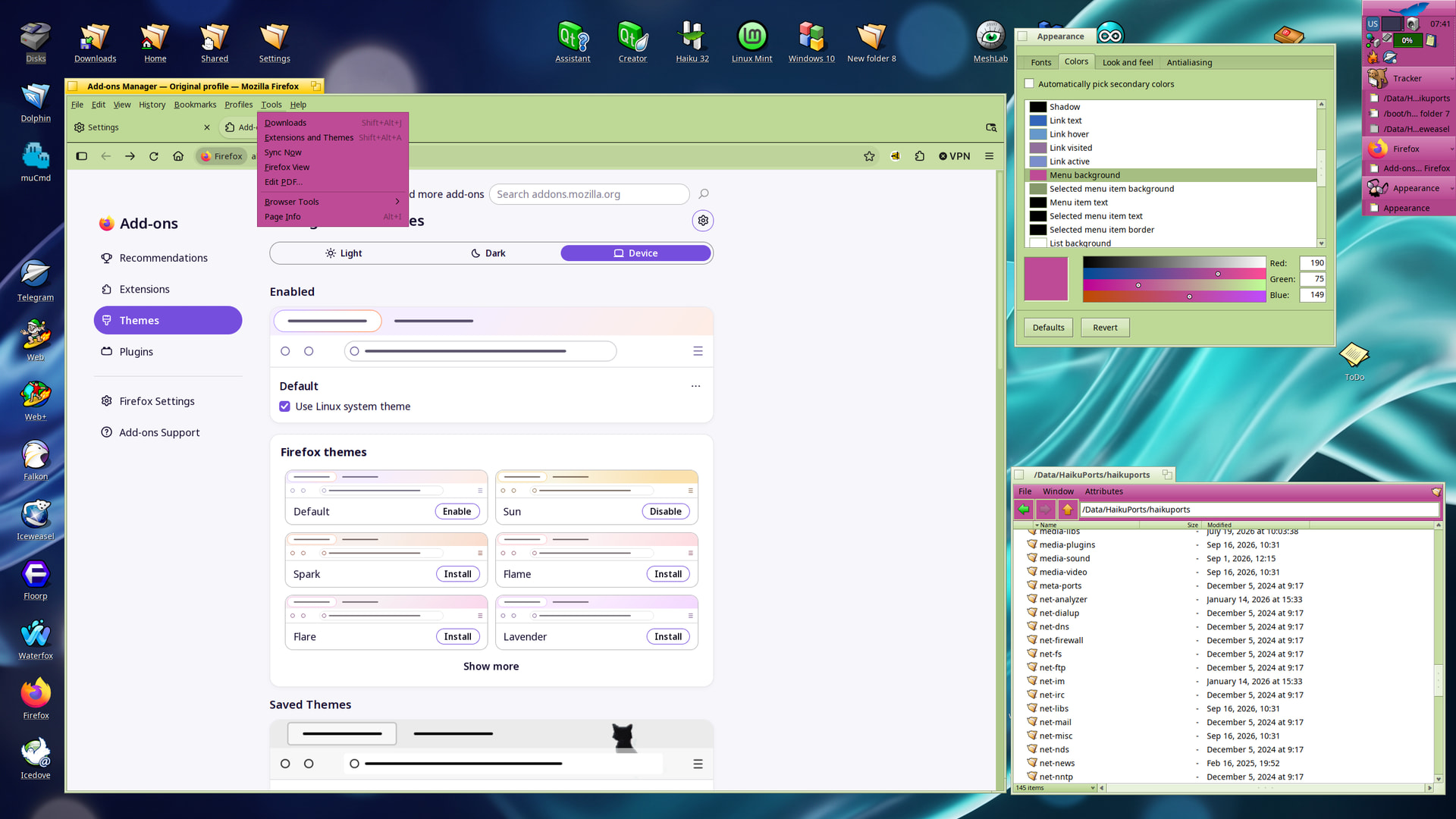
This means the browser uses base colors derived from system settings for its styling - such as the colors for menus, panels, selection highlights, and so on. This approach is standard on other operating systems, and now it applies to Haiku as well. Additionally, the dark mode setting is automatically determined based on the brightness of the panel’s base color. There is also an option in the theme manager - specifically for the default theme - to enable “Use Linux system theme” (for styling purposes, the browser currently treats the system as Linux, as this was easier to implement); enabling this causes the entire interface to be rendered using system colors rather than the specific theme colors. This is clearly illustrated in the screenshot, where I deliberately chose extremely garish colors to demonstrate the effect.
Does the browser identify itself as running on Haiku yet (both from JS and in the User-Agent)? The previous Iceweasel version (according to https://www.whatsmybrowser.org/) still identifies itself as running on Linux. I remember we did this deliberately in the beginning, but I think by now we should start identifying as Haiku?
That’s not the best idea - many sites (programmers who do this ought to have their knuckles rapped) have User-Agent checks in place, and for systems they don’t recognize, we’ll end up seeing a placeholder page claiming our browser is outdated.
To start, we can try installing an extension that allows you to dynamically change the browser’s User-Agent and conduct a series of experiments
Falkon/QtWebEngine on Haiku have reported “Haiku” to both JS and User-Agent for a long time now and I don’t recall any major issues here. Maybe we could at least make JS navigator.platform return “Haiku” instead of “Linux”?
Okay, I’ve found where the User-Agent string is generated and where navigator.platform is set. I’ll run a series of tests, and if everything looks good, I’ll include it in the next update
If “Haiku” instead of “Linux” does not work, maybe “Haiku” could be just added as additional keyword. User agent string is a dumpster of keywords and version numbers anyway, so one more additional keyword shouldn’t break anything.
I was trying to understand why I didn´t have this “Use Linux system theme” option, but it turns out you need to keep Nova (browser.nova.enabled) enabled. Just if anyone else reading it doesn´t care for the rounded tabs 
Thank you for this work on fitting FF to Haiku !
Would check derivatives as are arriving 

I want also to say a big TANK YOU guys, you are amazing
I remember as KENZ first wrote his post in forum, that he is a huge fan of Firefox and he managed to compile it, I thought this would be a dream for a far, far future and now this dream became true 
And the Firefox port feels even in a VM snappier than native Firefox in my Ubuntu distribution.
I even start to search for a used notebook to run Haku on bare metal - Great job 
1. Fonts
I noticed that the port uses always serif fonts for all categories - see screenshot 1
I think it would be more accurate if the fonts were separated in serif, sans and mono - so the sites can use what the developer of the site want to use. The discuss-site for example uses by default sans fonts - see screenshot 2.
2. Scrollbars
I hoped you could implement native Haiku scrollbars. I know they are not so fancy like the current one, but this would give more native look and feel to the port.
3. Future
I wish someone can manage it to upstream the changes to Mozilla, so the port would not end like our WINE port. It is a huge task to keep pace with Firefox development, they push every two weeks a new release and some minor updates in between, so It would be good if we could outsource the work.
That’s all - THANKS again and keep up the good work!
Regards
Using a specific User Agent for Haiku makes this a great target for fingerprinting,as there are quite few computers with Haiku out there.
Tor Browser and LibreWolf always use a “Firefox on Windows 10” User Agent because that’s a very common combination,to avoid that sites can uniquely identify you.
Since there are very few good reason why a site needs to know your OS (the only one I can think of is when offering application downloads),always identifying as Firefox on Windows 10 like Tor Browser and LibreWolf do makes most sense in my opinion.
I ran a series of tests using various combinations of User-Agent strings and navigator.platform return values, and I reached the following conclusions. Yes, it is possible - I checked many popular websites (including YouTube), and they work correctly - but there is no guarantee that we won’t encounter finicky sites that refuse to work with such a User-Agent. They might display “Browser not supported” or “Update your browser” messages, or simply render the layout incorrectly, since some sloppy developers make their layouts browser or platform-dependent. We might also run into issues where anti-bot heuristics flag the unrecognized browser.
And let’s not forget that we will never reach a consensus between users who don’t care about privacy (like myself) and those who are extremely particular about it.
I’m not sure what the best course of action is here, so I suggest leaving things as they are - at least for now.
As long as user agent can be configured by the user, which it should be. I think having the default be truthful is not such a bad idea. I have seen sites reject Edge as being incompatible when it’s just another Chromium based browser, and is quite mainstream at this point. Some web designers have their heads up their rear ends if they really want to limit who can access their site. If anything they should give a pop up message “For best experience use yada yada…” But flat rejection is a horrible design choice on their end. Most people will just use another browser, most likely on their phones, or avoid that site altogether, which is what I would do.
Identifying as windows is also a great way to get junk stuffed in your face ment for windows 
The only “real” solution is to opt-out, to not send any UA. Webkit has frozen their UA version number years ago and never updates it. There is also a mechanism there to send specific UAs to specific websites. So if there is enough want we could skip sending a UA, or do a simple “Desktop” or whatever and only bypass pages that absolutely need it.
I’m not discussing the ideal approach right now. The only question at the moment is whether to keep the platform part of the User-Agent as is X11; Linux x86_64 or change it to Haiku; Haiku x86_64. I’m fine with either option, really; in a pinch, one can always install an extension or change it manually via about:config.
That is the only issue, because I plan to submit patches upstream, and they shouldn’t contain arbitrary logic that doesn’t align with Mozilla’s current approach.
For upstreaming specifying Haiku makes the most sense imo.
If you don’t send any User Agent,you’ll get blocked by most Web Application Firewall services like Cloudflare.
Also,the marketshare of browsers without any User Agent is 0%,so that again makes you uniquely identifiable,while sending one that a majority uses does not.
Not sure what you mean with “junk meant for Windows” however - Application downloads?
Anything else shouldn’t be platform-specific on a website and I never came across any Windows-specific stuff other than application websites offering the wrong download by default.