I would love to have a look if you can shoot me a copy or make them available somewhere. They are different to the Themes I have found so far, and I don’t reinvent wheels:-) TIA
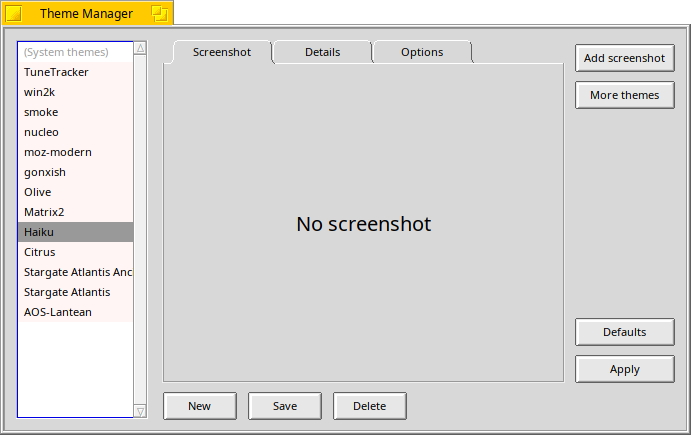
Could you guide me on the following, before I make a fool of myself again as a Noob. In Theme Manager there is a “MoreThemes” button. When I click on that nothing happens? What am I doing wrong? I read one thread where @humdinger said the “get more” way of working was not supported by Haiku. Is that the case here? I have been loading themes through HaikuDepot, that appear in ThemeManager but there are not many there.
IMHO that app is now obsolete with the recent update to the Appearance preference and should be removed. All you need to do is set three main elements’ colours and the rest get computed for you. It is absolutely brilliant.
Both of them can be handy, I store my changes in the Appearance preferrences into 2 different themes here, one for daylight, and one for evening (dark) mode, makes switching these 2 pretty easy
Agreed as I found useful setting in both with ThemeManager letting me test Themes others have developed and Appearance letting me tweak things (to save with ThemeManger if I want). They could be combined into one Manager with the theme save and load being a function within Appearance, but not a biggy.
I figured out my problem and why no-one answered “What does the “More Themes” button in ThemeManager do?” I already had HaikuDepot open and it snuck _theme into the HaikuDepot search bar without bringing the HaikuDepot window into focus in front of the other windows Nothing appeared to have happened LOL.
Is that a bug or punishment for being lax at window closing ?
ThemeManager is still useful but to use with care.
Among other things,
Decorators are saved with full path and a bad decorator can lead to app server crash.
Control look is not saved and few colours are not either.
It doesn’t save colours and fonts separately. So, you can apply a theme that requires fonts not on your system. Worse, if these fonts are found they may not render correctly with your language.
The “More themes” button is supposed to open a window to find themes online. It is really an old app that used to work on BeOS then Zeta and it has capabilities to import BeOS, Zeta and Win9x themes. I can’t remember it working on Haiku.
ThemeManager does more than system colours and fonts, and therefore doesn’t fit exactly into the Appearance prefs. It also stores the config of background images, sounds, screensaver and Terminal settings.
I use ThemeManager often to switch between my regular theme (bigger fonts, custom colours, background image) and “documentation themes” with Haiku defaults, or smaller font sizes, to make screenshots for the user guide and other docs.
There could be some improvements, like including Replicants on Desktop, locale settings and all Deskbar settings, etc. It could also re-start Tracker and Deskbar so the changes settings take effect.
If anyone wants to improve ThemeManager, I’m sure mmu_man accepts your PRs at:
Thank you for that very informative Post @humdinger. I was wondering about saving sound setups, and you saved me asking I must check it out.
Definitely ThemeManger is essential in developing/share superficial level Haiku usability, and personal tweaking for those who want to do it. I am interested why @michel said it wasn’t needed, unless he was thinking along the lines of my post.
I still think logically ThemeManager and Appearance could be integrated. Maybe I should have said Appearance should be subsumed into a revamped ThemeManager so usage is more obvious. That would mean Sounds and other thematic GUI(Deskbar, background, screen saver …) setting should go there too.
Sorry I haven’t upskilled enough to do it myself yet.
SuperPrefs available on HaikuDepot does this and integrates access to a lot of other user settings also! For me this would have been good enough as a Noob. I had to search around and find settings. This gives access to all in a logical GUI. I think something like this (maybe more integrated so it is the default Preferences/Settings access point) as part of the default Haiku GUI instal would a step in the right direction. Well done Anirudh Murali.
Edit: At risk of opening another Pandora’s box my above suggestions should be in line with a review of the Preferences start menu, because the same result as SuperPrefs could be achieved with less duplication and greater integration by including sub-menus (the categories used in SuperPrefs). This is what I am doing to “sort” my applications into submenus (no write access to put menus were I want, makes this a bodge work around ATM, and maybe why SuperPrefs does not implement that solution).
That’s the equivalent of what is known in the business world as “an increasing share of a shrinking market” aka the surest way to go broke. This movie clip lays it out rather well.
No, the parallels are not exact. For Haiku it is not a matter of “going out of business” but of “sliding into irrelevance”. But if we can use metaphors like “selling point” for a free product, then we can see how far the metaphor stretches.
Those old computers are no longer being made. Their capacitors start leaking, their screens crack and they end up as e-waste. Every year there are fewer and fewer of them. So even if we got 100% of that “market”, every year there will be fewer installations. Meanwhile all effort has been on maintaining that backwards compatibility. By the time todays new computers become old computers, Haiku can no longer run on them.
Far-fetched? You can see it right now with RiscOS. That community is even more fanatical than we are, but their entire focus has been on perfecting their 32-bit systems and they’ve barely started exploring 64-bit hardware. And now RiscOS will no longer run on a Raspberry Pi 5.
For the record, I think Haiku is getting it right. We are maintaining backwards compatibility where possible, but also exploring the latest and greatest. so our selling strategy should be “Haiku keeps your old computer alive AND it makes your new computer fly!”
Excellent point, michel, I hadn’t thought of that. It’s just that my current reason to use Haiku is for all my old computers that still work. Can’t speak for anyone else, and it shouldn’t be Haiku’s only goal. Certainly hoping to use it for many more years after those machines finally die! But it is my use case right now, and it does matter that even Linux is abandoning that kind of hardware.
And Haiku is just about the easiest thing to get into, even for people who don’t read the manual. Trust your fellow human beings a little. Dismissing them out of hand is how we ended up in a world of eloi and morlocks.
I can add to that: old hardware tends to be quirky and strangely designed. Newer generations learn from past mistakes and tend to be cleaner (even if not simpler). So, increasing support for legacy hardware can be harder than increasing support for new hardware which needs less workarounds.
We shouldn’t throw away the support for old machines that we have, and if someone is willing to put in the work for more driâers and fixes, we’ll accept and review their changes. But personally I’d rather work on somewhat up to date hardware instead.
Absolutely agree, and my post that started this thread was simply that potential users who are forced to dump a PC that Windows now deems inadequate, may think “I can load Linux” (everyone knows that route), but if Haiku was gotten into search engines as an alternative, it may increase the userbase. No effort except posting Haiku is a possible alternative for machines that Windows no longer supports.
I did propose a stripped down “Chrome Book” like version as a logical future development, but that was already done by BeOS it seems The only PC ever shipped with BeOS preinstalled – OSnews where the “Mac clone makers put a BeOS installation CD” was a stripped down instal with working a WebBrowser (due to the size limits of the CD). It turns out BeOS did a sort of “Chromebook” a decade before Google!
Getting some of the machines onto Haiku that Redmond blocked starting1999 would be poetic justice

 Nothing appeared to have happened LOL.
 I must check it out.