I installed BeOS on my PC sometime around 2005. I had been using Linux before that and trying various other alternative OS.
I got more closely involved with Haiku in 2008 with a failed GSoC application and then a succesful one the next year. I have learnt a lot from a friendly team of developers willing to spend the time to explain to me the things that I misunderstood, and helped me become a better developer.
I use Haiku because I understand it, and thanks to it I have a computer system that I can fix myself when needed. This is possible thanks to the all-in-one codebase as well as the team running it who is always available to help investigating things. There is still much to do, fix and improve, so I continue doing that. We’ll probably never get done, but it doesn’t matter, the journey is great.
I don’t remember how I discovered BeOS, but I do remember the WOW feeling that I experienced when I first used it. It was sooooo much better than anything else out there!
I was heavily involved in the project for a while in the early days. I was distanced for a long while due some unfortunate circumstances (that I regret to this day), but happy to see that Haiku has kept chugging along all these years and how far it has become.
I started with BeOS 5.0.3 right when it came out. I was so impressed by its speed, snappiness, and usability that I showed it to everyone during my IT training. I immediately started developing plugins for an audio visualizer – does anyone remember that app? I think it was called Pulse Visualizer or something similar. I loved the welcoming community and the well-documented API.
I stuck around for a while and even wrote my thesis on an app I developed using the Media Kit (back then on Zeta OS, focusing on immersive video). Later, I started developing Project Conceptor in my spare time between two jobs. Sadly, I didn’t have much time for coding after that, just a few small projects here and there. I was on and off the community for quite a while, but Haiku always remained my secondary boot system.
I stopped using Haiku in 2020, but I started again four months ago!
Since the very first installable alpha images were released.
What first brought you to the project?
I’ve been interested in technology since my 20’s and alternative operating systems fascinated me. I tried Linux in the mid 90’s and installed it on my home-made pentium PC which involved compiling a custom kernel and configuring the X window system by hand. Then a few years later I discovered BeOS 5 Personal Ed on a PC magazine and fell in love with its interface, snappiness and way of doing things. I kept using it as a secondary OS on my machine until the days of BeOS Max Edition. I was delighted when OpenBeOS was born and followed its progress from the first kernel boot to the first appserver demo to the first alpha release until now. It’s a beautiful story written by a few dreaming and courageous people who loved BeOS like I did. I’ve been installing and using Haiku on and off over the years. I find it a pleasure to use, its speed and simplicity. The fact that we can use so many applications on nowadays (mostly ports I know) is incredible, the huge port of openoffice was a milestone to me, then Qt which made it possible for me to compile Scribus a few years ago, the first port of this application, I guess, then came kde, and now firefox. I also value the efforts to port webkit and the making of webpositive.
And what keeps you around?
I see a huge potential in Haiku. Its clean, consistent and extremely fast architecture compared to macOS, Windows and Linux keeps me coming here to read this forum in search of new developments of the OS and its environment. Haiku is alteady quite good and usable but it still needs to advance more in terms of graphics and audio drivers, native applications and security. This last item is crucial in my opinion. Doing serious things on the internet nowadays with an OS without minimum protection or restriction against attackers seems crazy to me.
But even if Haiku doesnt get there I will still be using it for fun.
I was aware of Be OS, but never had a chance to use it before it died (blame… you know whom for that). Luckily some clever guys didn’t give up: They refused to accept “it is what it is”, rolled up their sleeves, eventually more people joined them, and voilà, Haiku is more than Be OS — made from scratch.
I tried Haiku several times over the years, initially because I’m interested on alternative operating systems. I really liked Haiku, but it was lacking the libraries I needed, so I couldn’t do my usual work with it. I kept trying new betas from time to time until, 3 years ago, I could move pretty much all my projects in Haiku. Since then, whenever the job can be done in Haiku, Haiku it is! When using another OS, I tend to hit Ctrl+Tab instead of Alt+Tab now, or Alt+C/Alt+V instead of Ctrl+C/Ctrl+V, Alt+Q instead of Alt+F4. and so on… When I realized that, I also realized I can call Haiku my new daily driver, except in special cases. There are rough corners and still a lot to be done but, for me at least, it is already good enough for daily use and very attractive because it’s also fun. Make Computing Fun Again, pun very much intended.
What first brought me to the project? The snappiness, simplicity, and the fact it doesn’t stand on my way, of course. On a secondary level, the looks and the fun factor.
What keeps me around? All the above plus the API. I found it weird at first, but soon I started to get it. If any Haikuer didn’t try the API yet, my message is give it a try and you won’t regret it. Start a modest native project, and soon you will start to appreciate the API, wondering why on Earth it’s so different and so complicated elsewhere. Oh, and those are words from someone who never liked C++ in the first place.
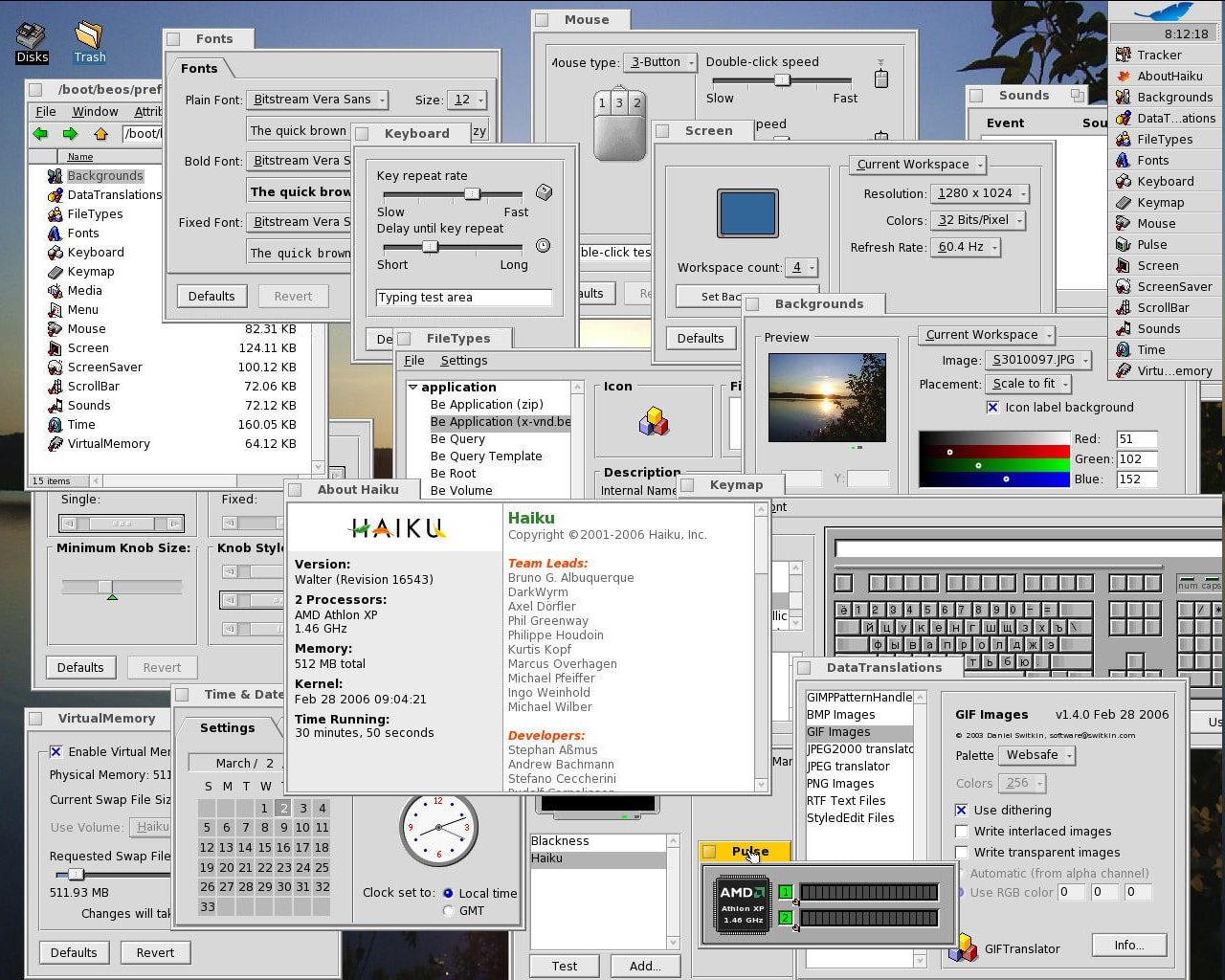
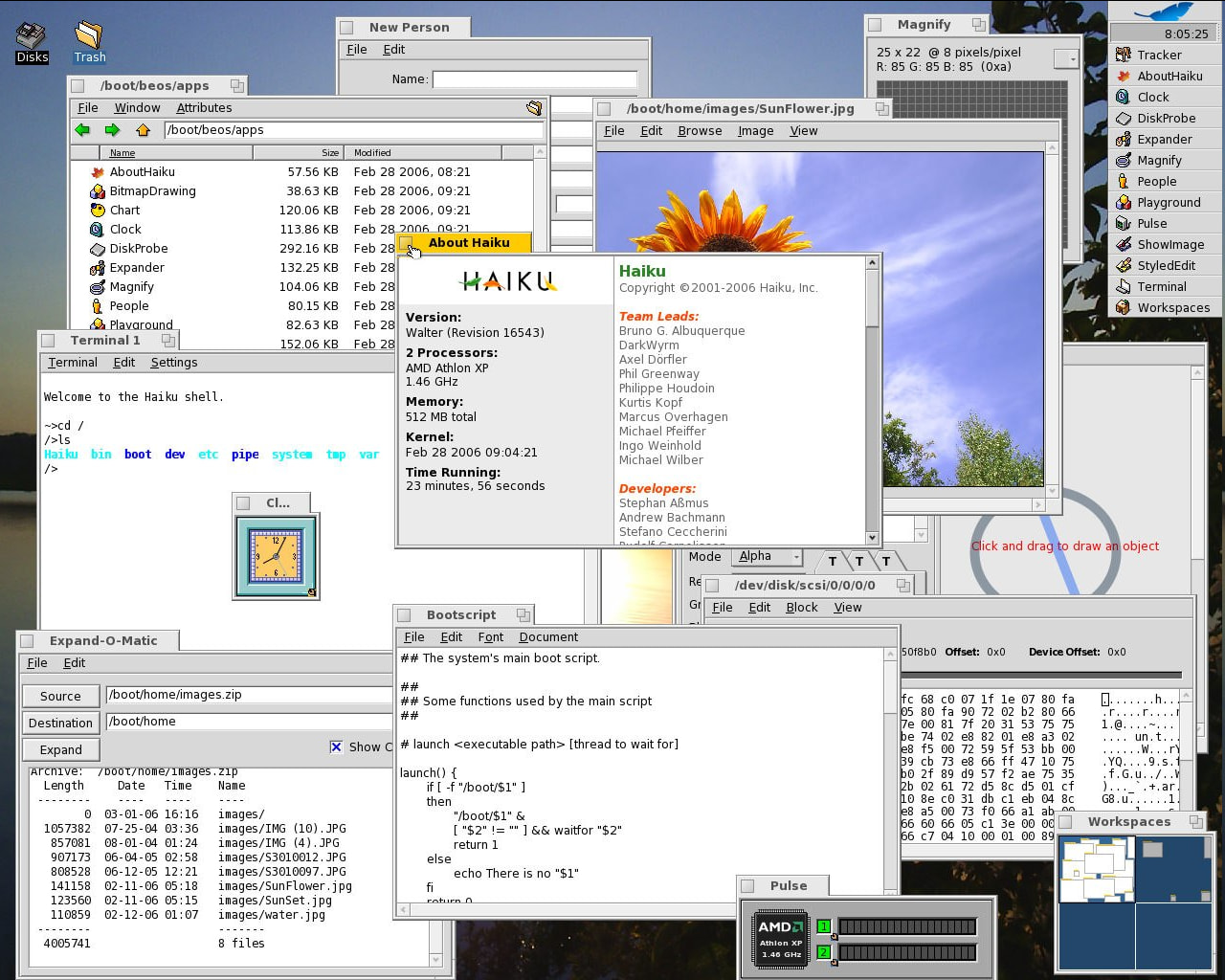
Since the beginning, but the first screenshot on bare metal i have from around 2007. It was on a Athlon XP 1.58 Ghz
My first contact with the project was on back in the #beos.de IRC channel and I remember playing around with mediakit replacements for R5 from Marcus Overhagen. This was before the rebranding to Haiku.
The community!!! and of course the system itself. Once you get used to it, you can’t go back to anything else, no matter what comes your way.
I used BeOS on a dual processor PC when OSBOS started, I remember running the OSBOS app server on my BeOS machine. All it could do was to move a mouse pointer (not the current hand icon) around a window in BeOS. I was hooked.
2020…COVID in full swing…was sitting idle…had read about this OS…installed it…appeared good…I had bought a PCIe Network card W881ND based on RTL8192EE…bloody thing was unsupported…opened a ticket (till date remains open)..got piqued…thought of forgetting this oS and move on…but was hooked by then…still using it
If Devanagari script support materializes, not much I could ask for…
Hope this get’s released in my life time…or I should live to see this released…going on 56…who knows…might not wake up in the morning…
Well, how long I’ve been using haiku? I can’t tell, I downloaded and run haiku iso images back in the days when vmware-ready images were offered among others, and I was glad when the devs released R1Alpha1. I’m sure I have an official disc of R1Alpha4 taking dust somewhere. Since then, I keep an eye on the site and the forum (with sporadical contributions), and play with haiku both on bare metal and in VM. Not so active lately, but always appreciating juicy news.
I swear I can’t tell what brought me here, but mainly my hunger for alternative OSs. I recall in the 90s reading about this impressive, fast, elegant OS called BeOS on an IT magazine (I mean, those made with paper!) but when I finally bought a decent PC, Be did no longer exist. Nevertheless, the idea of a light, multithread, integrated, peculiar OS stayed in my wishes (I really appreciate the combo of linux and a light DE such as xfce or mate).
I stay here mostly for fun. I find in this forum the feel of pioneering and discovering small pieces of progress, the same feeling a few people felt in the 90s around linux, before it became the huge business it is today (and it deverves IMHO). Last, I really hope some day (soon) I can give my old dad a haiku image he can play with - with more drivers and a strong security feel when online.
Kudos to the developers for their work towards R1B6
I don’t remember how I first found out about Haiku, but it was probably in the beta3/beta4 era. I never got to use BeOS but I remember seeing screenshots of it and all the cool things you could do with it. Back during the pandemic, I was stuck at home with the 'rona and had time to kill and severely interrupted sleep, so I loaded up the nightly on an old MacBook with a small SSD.
I used it all week until I had to go back to work. Obviously, this was before the Firefox/Iceweasel/Gnome Web ports so web browsing was mostly W+ and Falkon, but other than a few sites freezing and crashing, everything I wanted to do was possible. I did a lot of reading, playing some old games, ported a few utilities/apps for fun, and downloading torrents. My biggest kvetch at the time was the browser situation and the lack of tun/tap support. Both of those are fixed now.
This OS has come so far in the last few years and it’s thanks to the hard work of everyone who tested fixes, wrote code, fixed translations, ported apps. I’m very proud of where this community has taken Haiku over its 25 years. The simple desktop metaphor isn’t dead, and is thriving here.
I discovered/used BeOS since the R3 then 4.5 and 5 where I had the Pro Edition
Great OS, but not great story due to Be Inc decision to stop developing the OS.
Then I lost interested.
Haiku is a different story : I didn’t know about OpenBeOS but also Haiku at the beginning of the project, I think I discovered Haiku a few years ago but it was disappointing because I was unable to install it on my machine.
What first brought you to the project?
Since I was able to install the latest beta 5 on my Intel NUC
It was 2 years ago and since then I made a lot of researches to understand how to use the OS or port applications (Maria DB, Nifskope, contribution to Icon O Matic), trying to contribute to the community and finally I created Haiku Insider website.
And what keeps you around?
Lots of things to learn !
I find it amazing that an open source project like this continue to live 25 years after.
Some people would argue Haiku is a slow train, but we need to keep in mind it’s only living with the free time of people !
Most of us have a work and having time to dedicate to it is not always easy (myself included)
I have too much ideas for Haiku compared to the free time I can dedicate, so I must refrain myself sometime;)
My current occupation is for WebKit2 and Haiku Insider, which are already some big challenges
I first heard about BeOS back in 1999 or so when it was mentioned on the TV show “The Screensavers”. I started with the free PE version, then bought BeOS 5, GoBe Productive, and the BeOS bible. I dual-booted and used it as my primary OS for a couple year, and played around with AtheOS/Syllable too.
I kept a casual eye on Haiku over the years, but started using it more probably in 2019 and a lot more the past couple years.
What first brought you to the project?
Nostalgia for BeOS, the fact that Haiku is in a very usable state now (more so than BeOS was IMO). It’s remarkable how far the OS has come. Also I love reviving old hardware… it’s nice to save something from becoming eWaste by putting a lighter OS on it.
And what keeps you around?
Mostly for fun, and being able to revive my interest in older hardware. Being able to build some apps and fix a few bugs has been pretty fun.
How long have you used Haiku
I tried one of the Alpha versions around 2010-11? (VM) and liked the interface, but it wasn’t until 2022 when I actually installed it on real hardware and started using it for real (alongside Linux and Windows).
What first brought you to the project?
I found Haiku on a website listing alternative operating systems (including other interesting OSs like TempleOS and MenuetOS), that I tried out in VirtualBox. Several years later I found that the Norwegian translation on Pootle had stopped at ~50%, and decided to lend a hand with missing translations. This brought me to translating 3rd party apps, and eventually I discovered how much C++ I could learn by attempting to solve Github issues in apps like CapitalBe, BeMines and TAResizer.
And what keeps you around?
Fun, fast, constant improvements, and a friendly community. I find that I can do more and more of my actual work in Haiku, and I usually pick Haiku from the rEFInd boot menu unless I need a specific Windows/Linux program. (And I keep trying to resize Win-Linux windows using ALT-CTRL-Right click, I love that feature in Haiku).
I also really enjoy coding away on my own hobby projects.
In 2001, a colleague brought back a disc from Germany containing BeOS 5 PE. From that moment on, it became my main hobby; I began actively using BeOS both at home and at work - in fact, that was when I started porting software to create an environment where I could perform my job duties (specifically, ports of Samba and rdesktop). When Haiku appeared on the horizon - initially in the form of Kits replacing specific BeOS components like printing or translators - my focus began to shift in that direction. A turning point came when Haiku could finally boot to the desktop on real hardware; this was around late 2005 or early 2006. I even still have screenshots taken on my work computer, which ran on dual Athlon MP 1600+ processors. My first contribution to the project was an NTFS driver based on ntfs-3g.
Since there was little software available for Haiku and I wanted to use it as my primary OS, I turned to porting software - a task that truly captivated me, as I enjoy making things work in environments for which they weren’t originally designed. While the introduction of a package manager came as a shock to many - causing some to leave the project - for me, it was a decisive moment. I believe that the introduction of the package manager (specifically in the form it took) was the most crucial and correct step for the project; it prevented the project from dying out and attracted a multitude of new users.
Since then, I have used Haiku for all my home computing tasks; it is installed as the primary and sole operating system on my computer. I hope it stays that way.
I was looking for some summer work for my college, got to know about Haiku through GSoC program.
I started exploring Haiku and liked it from the beginning.
And what keeps you around?
Oh its very simple, I just like Haiku’s GUI so its very fun to use.
I like how much project has made progress since I first began using it, initially I used Haiku in VM but now I use it daily on real hardware without any issues so its nice
I started with BeOS R4 and bought all of up to 5 Pro I think it was. I love how easy the system is and it works.
Still up today I am sad that Be inc. stopped.
Ever since i stopped I looked at alternatives. Seen many pass by but Haiku is the most promising and probably the only alternative available.
although I use MacOS (OS X) back in the day I still once in a while check to see how Haiku is progressing. Love to see how the old BeOS is still a live in Haiku.