Ahoy devs ! Ahoy Haikunauts !
The most of the forum members possibly wondering why I created this post
in this category – ‘Software / Native’ – , instead of ‘Off Topic’.
I can make all of you assure – besides that : it is intentional --, I have a good reason for
to select the category that way.
The simpler answer is
as Haiku written mostly using C++, and of corse there is some C as well.
I am not a developer, but watching this video I understood some stuff that the developers generally does not share with us. I do not think that because they would intentionally hide from us, but may think it would be boring for us.
Some refreshing exception was about this, when Adrien (Pulkomandy, if someone needs rather a nickname ) wrote a series of articles about some patches are on Gerrit, but still not merged and why not.
Also, when we can get some explanation and stories about memory management refactoring
from Augustin (waddlesplash), that talked about replacing Haikus bit old solution ‘hoard’ to a newer and better one, and this was not a one smooth round but more, and more was probed, and was setbacks those cannot be spared at all, but finally concluded what works in Haiku now.
These writings consumes times, so we can agree on it what they said, or rather, wrote, when we had asked for more such content ..
They had answer so : they would spend it rather writing codes in such time than anything else.
Despite that I am glad they are free to decide on what they would spend on it in their free time, and even if just occasionally, they yet write such details too instead of fixing or improvements, or sometimes doing it even alongside.
I may not alone when I write :
we enjoy such background infos and decisions behind such code writing and solution selection(s), and we think it was worth to spend those time on it.
**
Ok, so this way you can find this interview in this category - it had been worth to watch it.**
Not just because the person, who became very sympathetic to me, but becase I saw recently, some month ago, about Palo Alto research lab of Xerox, the birth of GUI, the Simula language and its creator, a very interesting woman, and in that video was told that the C++ became that object-oriented language that Simula should have been, if the actual conditions are different for Simula, than happened in case C++.
Well, if you watch the video, and listen what Bjarne Stroustrup answer to ‘object-oriented language’ category, and you also that agree with him what he stated about languages’ purpose importance, what that language targets, or at least what its creator(s) purpose was intended for.. then you may agree, just as I think it’s not really true, as Simula has another purpose when was written.
Besides that he admits that the Simula has affection designing C++, and name it which was, but also says about what not “object-oriented” in C++.
In my post title I highlighted other topics from the interview, that is added in the Youtube, however in the link below the original title used for the given link.
My items :
-- Bell Labs as a resercher; I very like such historical stuff and anecdotes if shared ..
– C and C++: no need war; It caused me to remember Haiku devs discussed
on the forum , whether drivers should be written in C or C++ -
suggest to watch the video, for both sides ! 
especially if we are above C++ version 11.0 .. and C also modern version.
If I understood well what stuff went back to C
from C++ version 11.0 and what stated the professor.
Also was interesting what was in the beginning when
that was researched as developing in C++ woould be worth the
effort regarding to C. It is interesting which was told about the reserch.
– ship VASA; Based on this I finally understood those test scripts KapiX works on !..
and of course other devs also !..,
I just did not understand who runs them, as
we – I mean Haiku development – have no established Q&A team, to run
those methodical tests personally …
This way those scripts run at some phase of compilation - if I understood well ..
– AI code validation; Here you can listen code validation mess, but another
— for me a surprising perpective ----, that had not mentioned by Haiku devs,
but very reasonable, and should let speechless those would force
more some kind of AI usage addition in Haiku development.
However he also mention one area, where LLMs can be use safely, and has
strong features : creating texts, working with texts, and using them for that task
made human person free up times creating such texts, but rather reading/editing,
that gives more creative times for coding or else creative acts.
This is creating documentation and and I would add educational material as well.
– Quotes : Languages!!; I suggest to listen this part as important.
Below after the video I would like ask some
from the devs and porters, regarding to this part ..
(I liked the joke and I hope US residents won’t feel hurts)
– Quotes : Who’s C++ for ?; It was also interesting ..
Here on the forum, I was read posts about many
programming languages, and was ported to Haiku -
Some as requirements due to ported softwares,
some newer languages by needed by developers,
to support some things that was written in that
language, so was ported. Some old or now seemingly
obsolete, butwas ported someone as ‘Why not?’
some in progress, and some done, but it is just in a
personal git repo, or on a nachine, and not shared at all,
even in discoverable by a search engine -
You can here what the creator and for a while main
developer says about goal of C++, and
whom was targeted by creating it. Name it an another
language, and says that language and their creators’
purpose .. and states both succeeded.
– How to learn C++ today (2026)  , There are more members here, who commited
to learn C++ – here you can know what suggest …
… Bjarne Stroustrup
Creator of C++: Bell Labs, Negative Overhead Abstraction, Mistakes | Bjarne Stroustrup
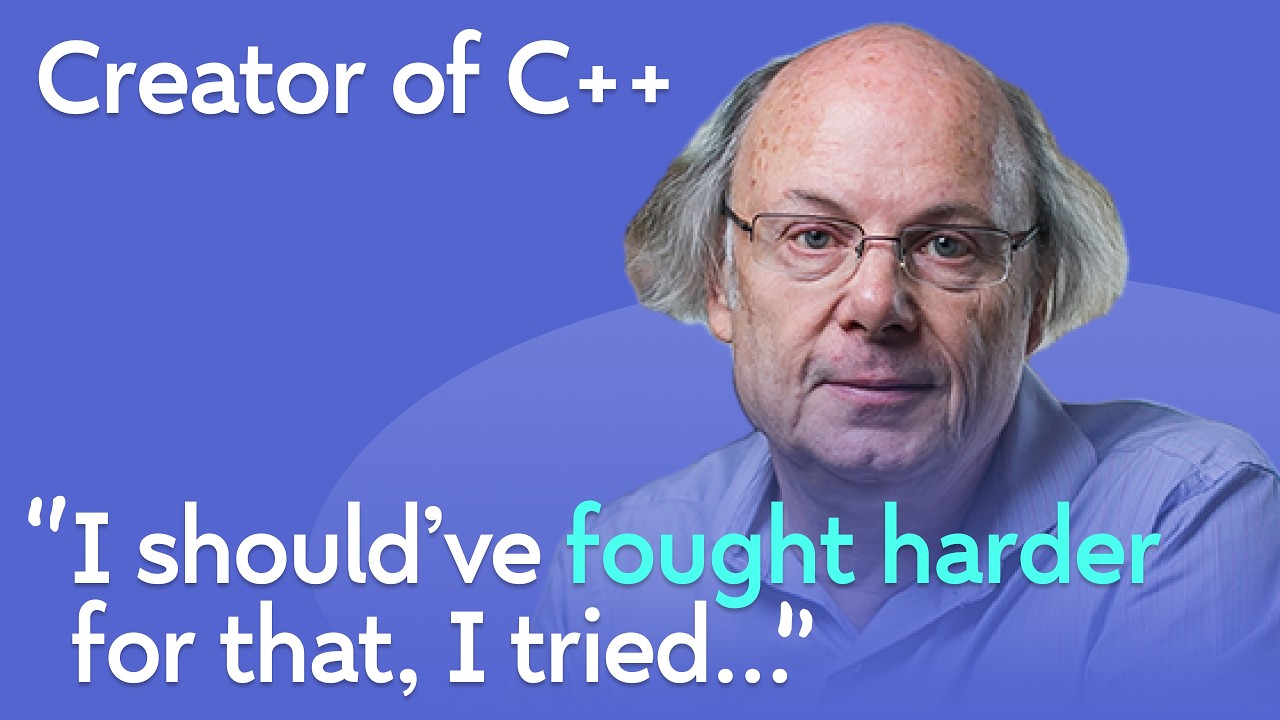
This enigmatic sentence above is and answer to a time travel - like question, in the video
it was naturally complered.
And finally the questions to the devs/porters, I promised above – feel free to answer or not.
Q1 : Had you feel the urge to get to know a programming language
other than the one you use most frequently?
(If that other language happens to be the C/C++, then we’ve already won! )
Q2 : *Had it became a different kind of language — as the professor first alluded to —
such as a scripting language or a shell programming language,
- which was an earlier era’s traditional choice -, or perhaps a markup language…
…or had it simply become a more modern programming language designed for a different purpose?*
Q3 : Have you managed to find the time and opportunity to keep your primary language
—perhaps C/C++ — aligned with the latest techniques and capabilities introduced
in newer versions?
(I ask this because I realize that many people’s skills are kept up-to-date by their employers, though I obviously don’t track how many contributors are self-employed or retired; I certainly don’t want to categorize anyone based on this — especially since I’m merely a beneficiary of the fixes and improvements, not a kind of juror, especially as I’m lacking the necessities.  .
I simply understand that maintaining confidence in one’s own expertise can sometimes be challenging — that’s the reason for my question.
Everyone should feel free to answer only what they wish to :-j )
